Showing posts with label public space. Show all posts

Tuesday, March 18, 2008

Bike Racks for a New City


On Friday the NYC Department of Transportation and the Smithsonian's Cooper-Hewitt, National Design Museum announced an international design competition for bike parking in New York City. The design competition's website explains that although U-racks, the current model, are functional in many ways, the current design "does not fulfill the potential to be an icon for New York City cycling."

They are soliciting a new design that will become the standard for sidewalk bike racks and racks inside buildings and garages. The City plans to add at least 500 bike racks per year to the existing stock of approximately 4,000 bike racks. Your design could be the new model. The international competition will be juried by a panel of experts from the worlds of industrial design, art and transportation.

Find out more and register at City Racks Design Competition.

Thursday, March 13, 2008

Hearing Today on Proposed Gowanus Development

Thanks to Eric McClure over at Park Slope Neighbor for this heads up on a hearing that's happening today about proposed development along the Gowanus Canal.
1) City Planning Scoping Hearing for Proposed Toll Brothers Gowanus Project, Thursday

Just wanted to remind everyone that the Department of City Planning will be holding a public scoping hearing tomorrow pertaining to the large housing project being proposed by Toll Brothers for a site along the western bank of the Gowanus Canal. A scoping hearing is the first step in the City's land-use review process. The final scoping document sets the "scope," or the parameters for what will be studied in the Environmental Impact Statement.

Toll Brothers Gowanus Scoping Hearing
Thursday, March 13th
2:00 to 5:45 p.m. and 6:00 to 8:45 p.m.
Department of City Planning
Spector Hall
22 Reade Street
Manhattan

Toll Brothers only recently revealed details about its plans to build a 577-unit mixed-income project (130 of the units would be below market rate) on a three-acre site along the Gowanus, bordered by Bond, 2nd and Carroll Streets. The development would include buildings ranging from four to 12 stories in height, with the tallest building, at about 125 feet, adjacent to the canal. The project would include a small amount of retail and "community" space, and 260 off-street parking spots.

The developer is seeking a special "spot rezoning" of the parcel in advance of a likely overall rezoning of the Gowanus by City Planning. The Gowanus Lounge has renderings and a map of the project.

More information, including downloads of the Draft Scoping document and scoping meeting protocol, and contact information, is available at the Department of City Planning website. Written comments regarding the draft scope can be submitted through March 24th.

If you're interested in the future of the Gowanus Canal, you might want to attend the hearing or submit comments. The City's willingness to consider a special rezoning for one site seems backward; some critics believe that a multi-agency Master Plan for the entire Gowanus should be put into place before any rezoning is undertaken. Count us among them.

Saturday, December 01, 2007

Mini Concerts in Back Alleys


Totally last minute but this looks cool. Enjoy before we're all confined to our mini-apartment muffled worlds by tomorrow's snow. Here's the 411 on today's performance, presented by Lower East Side gallery Smith-Stewart and local nonprofit Creative Time, just back from a nationally-acclaimed performance in New Orleans of Waiting for Godot:

Though your mother may have warned you not to go into the back alleys, this certainly won’t be the first time you ignore her, and this time for good reason. Creative Council Member Carlton DeWoody, with Jen DeNike and Smith-Stewart Gallery, invite you to a one-day rock out in Lower East Side.

Mini Concerts in Back Alleys
Saturday, December 1, 2007
2:00 – 11:30 PM
locations throughout the Lower East Side (see schedule below or click for more info)

Mini Concerts will make various interventions on sites chosen by each artist throughout the Lower East Side. Be it on a mews or median, in an alley or cellar, each site specific location marries the audience to the performance, which collectively can only be described as shiny moments in dusty corners. All performances are between 5 and 15 minutes long, and are only performed once, serving to expose the drama of time. In a land where ‘before’ and ‘after’ are as significant as the ‘during’, the planned meets the impromptu and the important meets the forgotten.

Here’s the musical line up featuring Creative Time curator Mark Beasley.
Schedule:
2:03 pm Rachel Mason Hamilton Fish Park- Pitt btw Houston and Stanton
3:11 pm Mind Castle Freeman Alley- Rivington btw Bowery and Chrystie
3:41 pm Dirt Mound Rivington btw Chrystie and Forsyth
4:29 pm Artic Circle Hester btw Chrystie and Forsyth
5:43.21 pm Y.O.U. 1st btw 1st and A
6:27 pm Mads Lynnerup 227 Bowery btw Rivington and Stanton
9:03 pm Georgia Sagri Delancy and Allen
9:36 pm Caroline Breton 162 Eldridge btw Delancy and Rivington
10:16 pm Brian Bellot 71 Hestor btw Orchard and Ludlow
11:01 pm Mark Beasley and Rose Kallal 35 Orchard btw Hester and Canal

Sunday, November 18, 2007

A Hole in a Fence


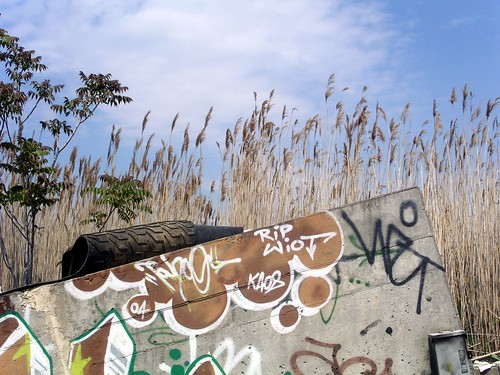
Last summer I was interviewed by D.W. Young, a documentary filmmaker, who was shooting a film about an abandoned lot in Red Hook. This chameleon of a site has been, variously, a graffiti spot, a homeless encampment, a formerly industrial truck loading zone, a magically-invisible overlooked and forgotten lot, contested urban space, a possible Ikea parking lot, and a reed-filled shallow pond. D.W. Young tracked me down because I had shot a series of photos of the site (you can see my set, Red Hook Marshland, on flickr).

The film, A Hole in a Fence, has just come out and is pretty damn cool. Young interviews a range of people about the site, from local teen graffiti artists who use the site as an artist wall, to a Yale Architecture School student interested in sustainable building, who used materials found on-site to build a shelter and live there for a week. And you can see yours truly opining about the site, and catch some of my photos.


Watch the trailer on YouTube.
Or go to the website for the film.

Tuesday, February 27, 2007

Fallen Fruit

Now this is an LA export that we'd be happy to have. Fallen Fruit is all about mapping fruit trees on public property so you can get your grub on. Oh yeah, and they also want to encourage the creation of community gardens and smart planning of public space. Beginning in the Silver Lake neighborhood of LA, Fallen Fruit later branched out and created fruit maps of neighborhoods in Seattle, Portland and Santa Fe. They also do some crazy shit like night fruit walks and communal jam-making. Above: what you can find in Griffith Park.

Tuesday, November 14, 2006

Engineering Public Space

Since becoming preoccupied with bike lanes, I've been thinking a lot about how the way a public space is designed can subtly control how people use the space. With bike lanes, I've been wondering whether the way that New York bike lanes are designed unintentionally invite drivers to park in them.

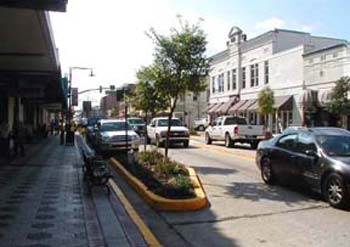
Dan Lockton, at the Architectures of Control Blog, writes about features designed into city layouts, buildings, and goods that are intended to influence user behavior. He calls these design features 'forcing functions' or 'techniques of persuasion.' Recently he wrote about a counterintuitive article in New Urban News. The article reported that roads planted with trees cause drivers to slow down, and drive with more awareness and caution.
Eric Dumbaugh, an assistant professor of transportation at Texas A&M ... looked at accident records and found that, on the contrary, wide-open corridors encourage motorists to speed, bringing on more crashes. By contrast, tree-lined roadways cause motorists to slow down and drive more carefully, Dumbaugh says.

Dumbaugh examined crash statistics and found that tree-lined streets experience fewer accidents than do “forgiving roadsides” — those that have been kept free of large, inflexible objects. He points to “a growing body of evidence suggesting that the inclusion of trees and other streetscape features in the roadside environment may actually reduce crashes and injuries on urban roadways”…

Dan Burden, senior urban designer for Glatting Jackson and Walkable Communities Inc. in Orlando, notes that there is research showing that “motorists need and benefit from tall vertical roadside features such as trees or buildings in order to properly gauge their speed.”

How could New York design roads, sidewalks and bike lanes in ways that similarly influence driver behavior in positive ways? And how can we identity and remedy public spaces that are producing unintended behaviors that run counter to intended uses?

Sunday, November 05, 2006

Peds vs Bikes vs Cars - What to Do?

Today in the New York Times, Samuel I. Schwartz, transportation columnist for The Daily News and the Department of Transportation’s assistant commissioner under Mayor Ed Koch, lays out the history of bike lanes in the City and proposes what we need to do to create more sensible transportation policy and better relations between pedestrians, bikers and cars.

Schwartz explains that Mayor Koch was first exposed to bike lanes on a trip to Beijing:
Mayor Ed Koch ... buoyed by a visit to Beijing, where he saw bike lanes used by tens of thousands, envisioned a network of physically separated bikeways up and down Manhattan.

In the summer of 1980, the mayor directed the department to install bikeways. From Washington Square Park to Central Park, the curb lanes of Fifth Avenue, Broadway and Seventh Avenue were separated from traffic by asphalt islands, giving bikers a lane of car-free roadway all their own.
The bike lanes were physically separated from car traffic using raised islands. New Yorkers had trouble adjusting to the bike lanes, and complaints poured in.
The department’s investigation found that pedestrians considered the bike lanes to be extensions of the sidewalk; they stood in the lanes waiting for the lights to change, where bikers often yelled at them. Mr. Koch made his own observations and found many bike riders traveling outside the lanes. He had us install traffic signs along the bike lanes in typical Koch-ese — “Use it or Lose it.” But even though the lanes were largely successful — and car traffic didn’t slow nearly as much as people thought — criticism mounted.
Faced with criticism, the mayor directed that the barriers separating bike and car traffic be removed, and that the bike lanes be marked only by painted lines. In hindsight, Schwartz thinks this was the wrong decision.
I think we made a mistake. We succumbed to the emotions of the moment. Had we kept the bigger picture in mind, we could have produced a network of separate bike lanes, a widespread public education program and tough enforcement that would have combined to promote good transportation policy and safety.
Now that New York has had 26 years of experience with bike lanes and bike policy, Schwartz has some thoughtful suggestions for the future. Among them:
  • we need to establish a clear hierarchy for the use of city streets. Pedestrians come first; we started out as a walking city and it will be our greatest strength going forward. This means bikers must yield to pedestrians — even errant ones. Biking is a superb form of transport we should encourage. Drivers must yield to bike riders — even errant ones.
  • let’s advance the network of bike lanes citywide. I’d even re-introduce physically separate bike lanes. This program needs to be communicated in a mass campaign explaining rules of the road and each group’s responsibility. For example, drivers need to know they are forbidden to enter a bike lane to turn; bikers need to know that they must not block crosswalks; pedestrians must learn they can’t use bike lanes as sidewalks.
Words of wisdom from someone who's been there.
Full op-ed: Rolling Thunder.

Wednesday, October 25, 2006

Good News From Around the City for Bikes & Pedestrians

Ever tried to cross from the Central Library at Grand Army Plaza to the farmer's market? Then you know that the timing of the lights will leave you stranded on a tiny traffic island as traffic whizzes by you in both directions. Streets Blog reported today that the Department of Transportation has corrected the timing of the lights, after repeatedly insisting that to do that would have a disruptive ripple effect on neighborhood traffic. DOT is also planning to implement other pedestrian-friendly changes at Grand Army Plaza over roughly the next year. Check out Streets Blog for the full report.

What effect does traffic have on neighborhoods? Besides what you might expect, Transportation Alternatives' new study, Traffic's Human Toll, found that New Yorkers living on streets with high volumes of traffic spend less time outside and are more likely to restrict their
children's outdoor play compared to people who live on "medium" and "low" traffic streets. The study also finds that compared to residents on low traffic streets, residents on high traffic streets are twice as likely to be disrupted by traffic while they are walking, talking, eating, playing with kids and sleeping.

Want to check out the Bronx waterfront? The Department of City planning has just released the Bronx Harlem River Waterfront Bicycle and Pedestrian Study, which proposes to improve pedestrian and bike access to the waterfront by adding off-street paths or striped bike lanes. Click here for the full report.

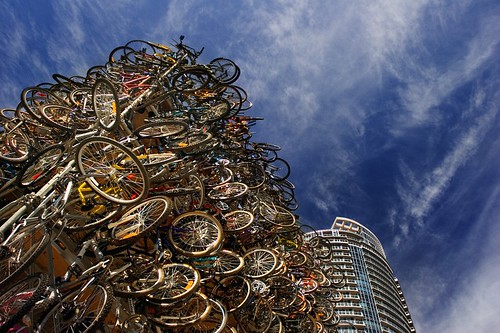
Photo, an inventive entrance to the bike path in Toronto, by mute*.

Thursday, September 21, 2006

Small Win for Critical Mass, Truth, Protest Rights

The National Lawyers Guild reports that charges have been dismissed against legal observer Adrienne Wheeler, who was assaulted by Assistant Chief Bruce Smolka on February 24, 2006, the night of a Critical Mass bicycle ride. Video Wheeler and the National Lawyers Guild – New York City Chapter (“NLG-NYC”) provided to the Civilian Complaint Review Board in March shows that, wearing plainclothes, Chief Smolka grabbed Wheeler from behind as she rode her bicycle past him and dragged her to the ground by a chain locked around her waist. Chief Smolka did this without identifying himself as a police officer or giving any warning. NYPD Officer Alfred Ortiz then issued Ms. Wheeler a ticket in which he swore he personally observed her ride a bicycle the wrong way on a one-way street – statements he admitted Friday were false.

“Falsely swearing in a complaint – even a traffic ticket - is an actual crime punishable by up to a year in jail, while traffic infractions and the like are categorically not crimes,” said Simone Levine, Wheeler’s lawyer. Levine, who helped coordinate the NLG-NYC’s mass defense efforts during the Republican National Convention (“RNC”) in August of 2004, testified before the City Council that the NYPD had targeted more than a dozen legal observers for arrest and prosecution during the RNC. Speaking for the NLG-NYC, Gideon Oliver, who has represented hundreds of the more than 650 people the NYPD has arrested on the nights of Critical Mass rides since just before the RNC, explained that “the NYPD has been at this for two years now and Chief Smolka and other supervisors appear to have developed strong personal investments in singling out legal observers for arrest and prosecution, likely because legal observers have called attention to repeated instances in which NYPD officers, not bike riders, have endangered the public safety, including by removing people from moving bicycles without warning.”

Officer Ortiz was accompanied to traffic court by Lt. Joseph Caneco, the head of Operations for Chief Smolka’s command, Patrol Boro Manhattan South. Lt. Caneco told the judge that Ms. Wheeler’s was “his ticket” and demanded to testify, but the judge made him wait outside the courtroom instead of offering him differential treatment. The judge then called the DMV in Albany and obtained a different version of the ticket Officer Ortiz had given Ms. Wheeler. Under oath and faced with that document, Officer Ortiz acknowledged having sworn under penalties of perjury that he had personally observed Ms. Wheeler riding her bicycle, although he had not, and agreed that it was unlawful for him to have signed the ticket at all, noting that he had been acting under his Lieutenant’s orders. After the judge dismissed the case for those reasons, Lt. Caneco demanded to amend the judge’s ruling. Rebuffed, Lt. Caneco and a group of top cops promptly stormed out of the courthouse.

Wheeler does not know the status of her CCRB complaint. Another CCRB complaint was lodged against Smolka in May of 2005 after he grabbed and arrested a woman for allegedly riding her bicycle on the sidewalk in Union Square Park on the night of a Critical Mass ride in April. Wheeler is not hopeful even two substantiated complaints would curb Chief Smolka or other top cops. “Commissioner Kelly has consistently given passes to supervisors against whom the CCRB substantiated RNC-related complaints,” Wheeler noted, “and so much for the NYPD’s commitment to internal policing.”

Oliver said that the City Council and the Office of the District Attorney were responsible for turning a blind eye to widespread “testilying” in what the DA considers “protest cases” since the RNC, and called NYPD brass to task for putting rank and file officers in the position of having to choose between following orders and perjuring themselves or telling the truth under oath, thereby risking prosecution for having made unlawful false written statements. “Top ranking members of the NYPD, habituated to having their orders followed, do not have a leg to stand on when judges insist on following the law,” said Levine. “If we want the police to stop breaking the law,” added Oliver, “we must not only protect legal observers like Adrienne, but also watch the police ever closer. Responsible government requires that kind of accountability.”

More at NLG, OnNYTurf.

Tuesday, August 22, 2006

Cars in Bike Lanes Handy Hand-Out

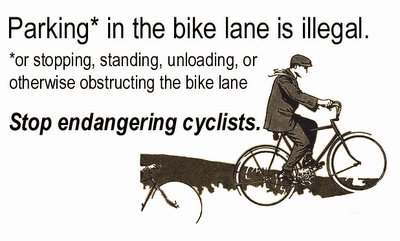
As a follow up to my previous post proposing that people take pictures of cars in bike lanes, here's a flyer I made that you can print and hand out. Click through for a sheet of six. PS- post your pics here.

Friday, August 18, 2006

NYPD Plans to Modify Proposed Parade Rules

Newsday reports that the NYPD has decided to withdraw their proposed parade rules, but plans to submit modified plans shortly.

Criticized, NYPD withdraws new definition of "parade"

By David B. Caruso

"A new rule that would have banned more than 35 people from walking together on the sidewalk without a parade permit is being abandoned because of public outrage, the police department announced Friday.

Proposed in July, the department's new policy on parades had been ridiculed by some as an outrageous restriction of civil rights that would have applied even to groups of schoolchildren or busloads of tourists. Spontaneous demonstrations of all but the smallest sizes would have been outlawed by the rules, critics said.

Police Department spokesman Paul Browne acknowledged the criticisms Friday. He said although the department doesn't agree with many of the complaints, it had decided to make changes. A new version of the parade policy is now in the works that would eliminate any reference to sidewalk gatherings, he said.

"Common sense has prevailed," said Christopher Dunn, an attorney for the New York Civil Liberties Union, which opposed the changes. "From the outset, everyone recognized that the proposed rules swept far too broadly, and we're pleased the police department has now realized that," he said. "There is simply no reason for requiring field trips, sidewalk marches and lawful bike rides to have police permits."

The revision of the parade rules had been prompted by the department's running battle with participants in a monthly group bicycle ride known as Critical Mass. Once a month, scores and sometimes hundreds of cyclists gather in Manhattan for a group ride down city streets. The rides have been going on for a decade, but since the 2004 Republican National Convention the police department has been insisting that the cyclists need a parade permit. Participants have refused to apply for one, saying they shouldn't need police permission to ride their bikes, as long as they obey all traffic rules. So far, the courts have ruled for the cyclists, in part because of a lack of clarity in city regulations.

Browne said the department is already planning another try at a revision.

The latest proposal, he said, is expected to require any group of 10 people or more to get a parade permit if they intended to travel on a city street in a manner that does not comply with all applicable traffic laws. Any group of 20 people or more on foot, in cars or astride bikes would be required to get a permit, even if they did obey traffic rules.

It was unclear Friday whether that would satisfy critics. "We would oppose any proposal that would require a police permit for people lawfully riding bikes or driving on a roadway," Dunn said."

The public hearing on August 23rd has been cancelled. Follow the issue at Assemble for Rights.

Thursday, August 17, 2006

Cars in Bike Lanes: A Modest Proposal


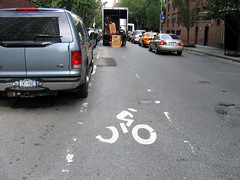
Cars park in bike lanes constantly, forcing cyclists out of their lane and into traffic. Anyone who bikes knows how dangerous this is. Drivers use the bike lanes with impunity, knowing that the cops almost never do anything about it.

To combat this, I started a group on flickr called Cars in Bike Lanes. Think of this as the flickr equivalent of posting john pictures in the newspaper. Your behavior doesn't look quite as pretty in the light of day, now does it? If the danger drivers pose to cyclists' lives isn't enough to convince them not to do it, perhaps public shaming will.

I invite everyone - bikers, pedestrians, people with cameras - to post their own examples of cars parking in bikes lanes. Include as much description as possible - the exact location (address or street and cross street), license plate number, date and time, and any other information - for example, your interaction with the driver, that the driver pulled over to read the paper, that the driver almost hit a cyclist pulling in or out, etc.

My hope is that by posting these pictures, city officials will gain a better understanding of the scope of the problem and some of the hot spots, and we'll give drivers an incentive not to be willfully oblivious to cyclists.

Photo by ianqui

Thursday, August 10, 2006

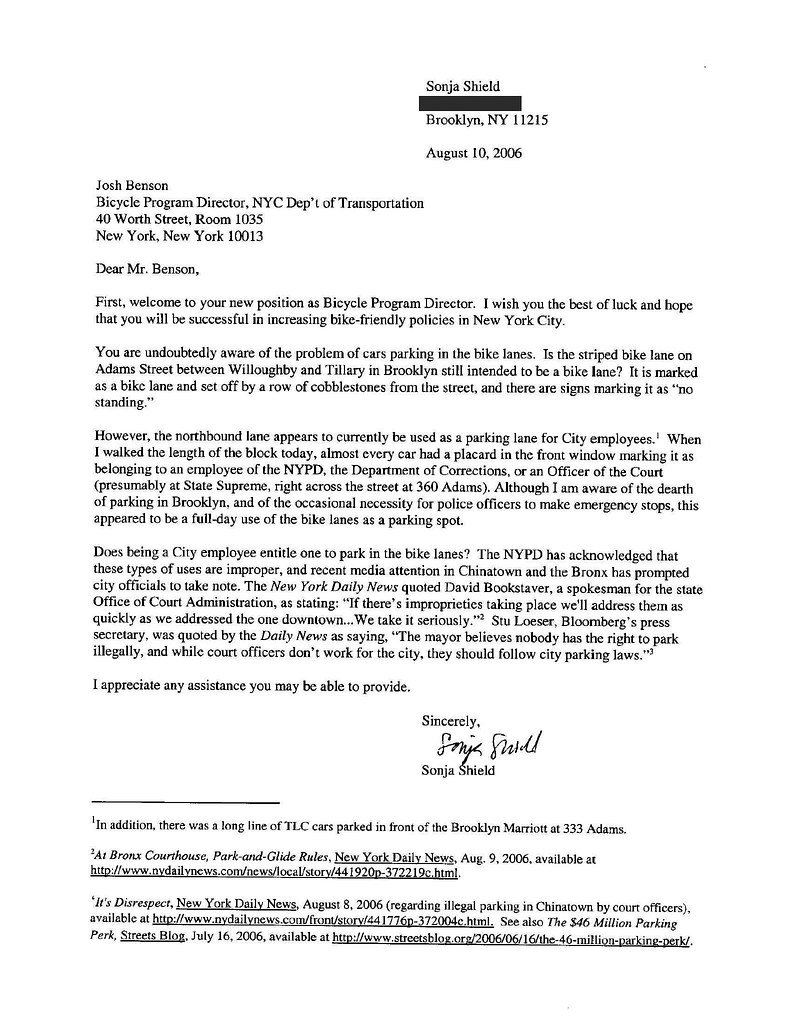
Letter to DOT Bicycle Program Director

I sent this letter today to Josh Benson, the new director of the NYC Dept of Transportation's Bicycle Program. It's about the city employees who use the bike lane on Adams St in Brooklyn as an all-day parking spot. Sorry about the quality of the thumbnail - click the photo to read it more easily.
Letter to NYC Dept of Transportation
Some background: Benson became the DOT's Bicycle Program director a few weeks ago, after predecessor Andrew Vesselinovitch resigned in protest against what he saw as the DOT's recalcitrance in implementing policies that would make city biking safer. "The city certainly hasn't done everything that it can do to make it safer, or to really use bicycles," the Sun quotes Vesselinovitch as saying.

According to Streets Blog, Benson is himself an urban cyclist who served as the DOT Bike Program's Deputy Director in the early 2000's and more recently worked for the NYC Housing Authority.

For more, see: Resident, the Daily News on DOT's Commissioner Iris Weinshall, NY Sun on Vesselinovitch's resignation, comments from Streets Blog about the need for improvements to bike lanes in New York.

Thursday, August 03, 2006

Brooklyn News Roundup: Transportation, Biking, Red Hook

Transportation News
Mayor Gets Bumper to Bumper Criticism From Borough: Brooklyn neighborhood associations criticize mayor for focusing on maximizing traffic flow instead of calming traffic. [Courier-Life Publications]
Every Group Hates Traffic: “Brooklyn’s gotta grow. But it’s gotta grow smart.” [The Brooklyn Papers]
Mayor Bloomberg Says NYC Traffic Congestion is Good: “We like traffic, it means economic activity, it means people coming here.” [StreetsBlog]

Biking News
NYPD Sets Up Checkpoint to Ticket Cyclists on Central Park Bike Path [Bike Blog]
Brooklyn Bike Riders Forum Tracks Brooklyn Bridge Dragnet [BBR Forum]
Straight From the Horse's Mouth: “A loyal bike blog reader ran into a scooter cop on the Manhattan bridge and stopped to chat with him. He said he was from the 84th precinct in Brooklyn and that there was going to be a detail of cops on all the bridges from now on.” [Bay Ridge Talk]
New Blog Opposes NYPD’s Proposed Parade Rule [Assemble For Rights via Gowanus Lounge]
Bicycle Tsar Quits, Saying Goal To Increase Safety, Lanes Is Stymied: “The city certainly hasn't done everything that it can do to make it safer, or to really use bicycles. . . Right now there are a lot of obstacles that the city can improve and in recent years has even created.” [NY Sun]
City Bike Boss Rips Brass and Pedals Off: “Former Bicycle Program Director Andrew Vesselinovitch blamed the DOT for installing dangerous bumps on the Williamsburg Bridge bike path and for failing to build more bike lanes.” [NY Daily News]

Red Hook News
Advocates Refuse to Give Up On Red Hook Graving Dock: “Ikea could choose to be a hero—if it preserves the graving dock.” [Courier-Life Publications]

Friday, July 28, 2006

NYPD to Peds: Two People is a Parade

The NYPD is trying to get a new rule passed that would limit how many people could legally walk down the sidewalk or ride their bikes together. Under the new rule, if two or more people ride or even walk in a way that doesn’t follow every traffic law, they would be a “parade” and would have been required to get a permit before setting out. Civil rights attorney Norman Siegal notes that this means a family out for a bike ride would be considered lawbreakers and subject to arrest. Cyclists say new rules ride roughshod on liberties [The Villager]

Transportation Alternatives points out that these new rules would mean that anyone who walks to the park with their child, friend or neighbor and jaywalks could be arrested; school teachers who walk their classes to the park would have to get parade permits; any two cyclists who do not have bells on their bikes, do not ride in bike lanes or take their feet off the pedals (violating NYS VTL 1232) could be arrested. I'm sure you can think of many more examples.

In a really disgusting measure of who supports the NYPD's new rule, New York Post columnist Steve Dunleavy says “The cops have finally gotten the go- ahead to bust the political pedal pushers who under the radar call themselves Critical Mass and arrogantly claim they own our roads. But the cops aren't going far enough.” Dunleavy urges the city's cab riders and motorists to throw open their car doors in front of "pedal punks" riding their "maiming machines" and "take back the streets" from bike-commuting "kamikaze jerks." [NY Post]
Inebriated Columnist Issues Fatwa Against Kamikaze Jerks: Response and fact-checking of Dunleavy’s rant [Streets Blog]

What can you do? There is a public hearing on August 23rd at 6pm at 1 Police Plaza in Manhattan. Go to it and make your voice heard, or write them a letter. Read the text of the proposed rule. More on this from Time’s Up and TransAlt.

NYPD Bridge Dragnet Targets Bicyclers

In the latest round of NYPD versus bicyclists, Sunset Parker reports that the NYPD has put up a bike ambush on either side of the Brooklyn Bridge to catch bikers who - god forbid - ride across the bridge. If riders don’t dismount and walk their bikes across the bridge, they get hit with a summons and a $60.00 ticket. Sunset Parker wisely point out that there’s been a portion of the bridge designated for bikes for 123 years, which you can see from the clearly marked bike path and outline of a bicycle painted every thirty feet or so. [Very Big, Very Bad News for Brooklyn Bikers, Sunset Parker]

When I say this is an ambush, I mean it - signage is poorly lacking, meaning that riders have no notice that they face a ticket. Although the tickets are probably legally insufficient, since you need to have notice that you're breaking the law in order to be liable, the NYPD has long known that legality is beside the point. Plenty of people won't bother or don't have the time to contest the ticket, so it's sufficient for their purposes to flood bicyclists with tickets, even if the tickets wouldn't ultimately stand up in court.

Every so often, the NYPD embarks on a massive campaign to ticket bikers, usually ignoring far more dangerous driver behavior like speeding and reckless driving. Bike advocates and riders around the city have tried for years to educate the NYPD and the City, yet they persist in these indiscriminate quota-driven campaigns. [TransAlt]

It appears that this latest dragnet was spurred by the death of a pedestrian who collided with a biker on the bridge. Although this is tragic, and we all bear the responsibility to bike safely, these occurrences are so rare that the NYPD should really be focusing on the real problems: the risk to bikers and drivers from driver misconduct. Charles Komanoff, president of the pedestrian rights organization Right Of Way conducted a study finding that between 1994 and 1997, motorists killed 1,020 pedestrians and cyclists - comprising 56% of all traffic fatalities. Of these, the vast majority were pedestrians. An analysis of fatal bicycle crashes with car found that most were caused by traffic-law violations by motorists. The primary types of driver misconduct were (1) driver passing cyclist unsafely or aggressively; (2) driver turning into cyclist’s path; (3) driver speeding; (4) driver running red light or stop sign.

(Correction - According to the Brooklyn Record, the ticket is for failing to dismount on the Manhattan side near the stairs to the 6 train. Brooklyn Ramblings has ridden across the bridge countless times, yet I have no idea where these stairs are, and therefore where I'm now expected to get off my bike. But ok, I guess I'm allowed to ride across, until the gotcha at the end. Thanks, NYPD.)

More coverage of this story:
Brooklyn Bridge Bikers Beware [Bay Ridge Conservative]
Cops on the Bridges [Bike Blog]
Into Our Town the NYPD Came [Streets Blog]
Photo of burning citation from Bay Ridge Conserative.

Friday, July 21, 2006

Gowanus Canal Redevelopment Plan Released


Urban planning graduate students at NYU’s Wagner School have just released a study proposing a redevelopment plan for a contaminated 6.5 acre site on the Gowanus Canal, bounded by Smith, Hoyt, and 5th Streets. The students spent the last year interviewing stakeholders in the community, conducting a survey of residents and workers in the area, and understanding the history of the site to identify issues and develop a plan for the site.

The site, known as Public Place, was the site of a manufactured gas plant operated by Brooklyn Union Gas, the predecessor to KeySpan. Today, the site is highly contaminated, mostly vacant and underutilized. It is, however, in a central location between residential uses to the north and west, and industrial uses to the south and east, and is close to mass transit. It is one of the larger, mostly vacant, city-owned sites remaining in New York City.

The group solicited survey responses from anyone living or working within ½ mile of the canal. In addition, they interviewed representatives of city and state agencies, elected officials, community advocates, local artists, and advocates for issues such as the environment, industrial retention, affordable housing, and open space.

Not surprisingly, there were many competing interests among the stakeholders. As a local politician stated: “Gowanus is like the Balkans.” However, the study was able to identify some broad areas of agreement. The major themes identified by the survey are:
  1. Open space and outdoor recreation/park are strongly preferred.
  2. Community facilities and work space for artists are preferred.
  3. Support for residential and retail uses exists.
  4. If the site includes retail, community support for a grocery store is strong.
  5. Mixed-use redevelopment is preferred.
  6. Support for affordable housing is strong.
  7. Industrial and manufacturing facilities and commercial offices are not preferred.
  8. The community seeks a range of waterfront and public park amenities.
  9. Buildings on the site should be 3–5 stories tall.
Most respondents agreed that Public Place should include some waterfront access and open space. There was general agreement that the ground floor of any development should be open to the public. Stakeholders for the most part supported the inclusion of affordable space for artists, seniors, or low- to middle-income residents. Finally, there was wide recognition of the canal as a community asset and a desire to leverage the waterway as a community amenity.

The group created four scenarios in order to identify the optimal combination of height, residential units, and affordable housing units. The four scenarios all have the same building footprint of 128,100 square feet, a 3-acre park with a waterfront esplanade, and a 23,100-square-foot community facility.

The scenario that the research group believes strikes the best balance between providing affordable housing, adhering to neighborhood context and architectural character, and generating the maximum economic impact to the city is the one shown above. It envisions a three-acre park, a 35-foot waterfront esplanade and a boat launch, a 23,100-square-foot community and cultural facility, and a mixed-use development incorporating a combination of retail and artisan work spaces on the ground floor and three to five stories of residential units above.

The research group also made recommendations as to the short-, medium-, and long-term steps that will need to be accomplished in order to make the most of the Gowanus site. The crucial short-term goal is to develop a remediation plan in collaboration with KeySpan, and clean up the environmental problems both on the site and in the canal. Next, they suggest that the city work with the community to develop a Request for Proposals that it can issue to the development community. The city should then choose a developer and have the site rezoned. An environmental review culminating in an Environmental Impact Statement will be necessary.

Congratulations are in order to Wagner for this extremely thorough study. They’ve done an excellent job of reaching out to community members and incorporating their recommendations. The Public Place site has been an unutilized blight for a number of years, and it has the potential to become a significant boon to the neighborhood.